







A rock wool roll is a flexible mineral-fiber insulation format for continuous coverage; the right choice depends on the surface, assembly, and required evidence.
Rock wool roll insulation is a flexible blanket or roll used to reduce heat transfer and, where the complete design supports it, help manage sound and fire-related requirements. Select it by application, geometry, operating conditions, and verified product data.
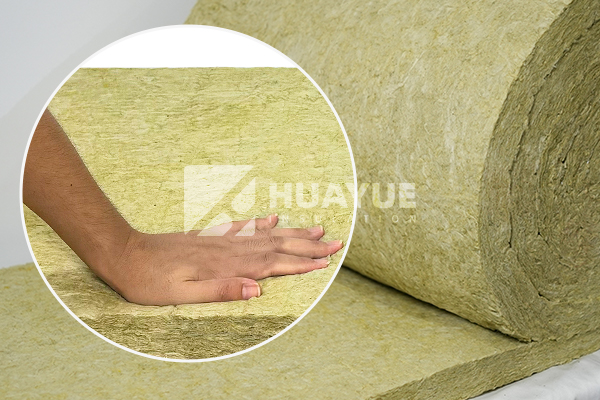
The questions below explain where a roll format fits, how buyers should describe its size, and when a board or batt may be the more practical choice.
Does Rock Wool Insulation Come in Rolls?
Buyers often see board, batt, blanket, and roll used in the same quotation.
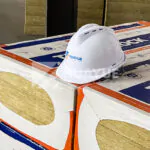
Yes. Rock wool insulation can be supplied as a flexible roll, also called a blanket, as well as in board, batt, pipe-section, or loose-fill forms. The physical form changes the installation and selection task.
Rock wool and stone wool are generic material terms within the mineral-wool family. A roll or blanket is a continuous flexible format that can be laid across a broad area or wrapped around a surface, while a board is more rigid and a batt is normally supplied as a defined piece for a framed cavity. A pipe section is preformed for a cylindrical service. These forms should not be treated as interchangeable simply because they share the same material name.
The U.S. Department of Energy’s Building Science Education resource lists rockwool among bulky fiber insulation materials and emphasizes that insulation must be considered together with air sealing, the building components, and moisture control. For industrial work, the Insulation Institute describes rock wool blanket insulation as a flexible form used around pipes, tanks, vessels, ducts, fittings, and process equipment. Those are generic form and application descriptions, not proof that every roll is suitable for every assembly.
The wording also matters in procurement. Lowercase “rock wool” or “stone wool” normally describes a material category. Uppercase <code>ROCKWOOL</code> identifies an unaffiliated brand. A buyer should state whether the specification requires a named brand, a generic rock wool product, or an approved equivalent. The rock wool and mineral wool terminology guide can help resolve that distinction before quotations are compared.
For a roll inquiry, ask the supplier to identify the exact product form, intended application, thickness, width, roll length, facing or jacket, and any required support method. Product availability, dimensions, density, thermal values, fire classification, and temperature limits must come from the current approved document for the named model.
What Are Rock Wool Rolls Used For?
The roll format is most useful when the project needs continuous coverage over a broad, curved, or repeatedly sized surface.
Rock wool rolls may suit walls, roofs, ceilings, floors, ducts, tanks, vessels, pipes, and equipment when the selected product, support, facing, and complete assembly match the project conditions.
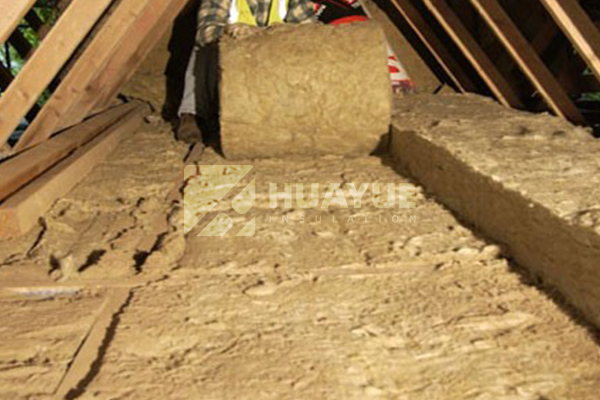
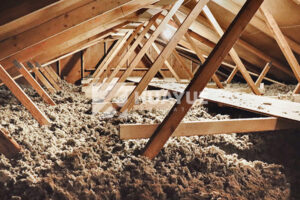
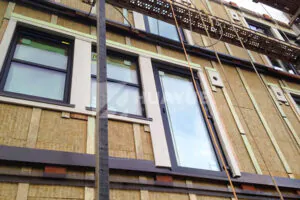
In building work, a rock wool roll may be considered between or over framing members, across roof or ceiling zones, or within other assemblies that permit a flexible insulation layer. Its continuous format can reduce the number of separate pieces on a large, uncomplicated surface. The installer still needs to maintain full coverage, control joints, avoid unnecessary compression, and follow the assembly’s fixing and protection requirements. A roll should not be selected only because it is quick to lay out.
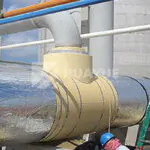
In industrial and HVAC work, flexibility can help when the surface is curved or when a continuous layer must follow a large radius. Generic industrial guidance includes applications around large piping, tanks, vessels, duct systems, fittings, and equipment. The correct form can change with the operating condition: a hot surface, a cold surface, a weather-exposed jacket, a vibrating service, and an indoor dry assembly do not present the same moisture, support, or protection requirements.
The roll itself is not a waterproof layer, vapor-control design, fire barrier, or complete acoustic system. A facing or jacket may be part of the design, but it does not automatically make every seam, penetration, joint, or outer cover continuous. Similarly, a material-level fire statement does not establish the time rating of a wall, roof, enclosure, or firestop assembly. Match the product document and the installed construction to the requirement.
The existing rock wool blanket guide is the better route for a deeper discussion of industrial blanket moisture control and vapor-control decisions. This roll guide stays focused on form selection and quotation preparation. For installation details, use the rock wool installation guide after the product and assembly have been defined.
What Size Is a Rock Wool Roll?
There is no universal rock wool roll size across suppliers, product models, markets, and applications.
Specify a rock wool roll by thickness, width, and roll length, then add the coverage, density or model, facing, joint plan, and project conditions needed to confirm equivalence.
%[rock wool roll end view with measurement points for thickness width and length](https://sinoinsulation.com/wp-content/uploads/2026/08/rock-wool-roll-size-and-order-check.jpg”Rock Wool Roll Size and Order Check")
The simplest order line starts with the physical format and three dimensions: roll thickness, roll width, and roll length. The area covered by one roll can be estimated as width multiplied by length, but the net usable coverage is affected by joints, openings, cuts, direction of installation, and any overlap or edge treatment required by the design. Do not use one universal waste percentage before the cutting layout is known.
Thickness should come from the required thermal, acoustic, condensation-control, or assembly target. It should not be chosen from the word “roll” alone. Width affects the number and location of longitudinal joints. Length affects handling, lifting, storage, and the number of end joints. Density may affect the product’s declared performance, mass, support, and pack configuration, so two rolls with the same face area are not automatically equivalent. A facing or jacket also needs to be named because it can change the installation direction, seam treatment, moisture strategy, and quotation.
| Order field | Why it matters | Buyer check |
|---|---|---|
| Application and surface | Defines the roll’s role in the assembly | Wall, roof, ceiling, floor, duct, pipe, tank, vessel, or equipment |
| Thickness | Connects the product to the required performance target | Drawing, code, calculation, or project specification |
| Width and length | Determines coverage, joints, handling, and cutting | Net area, installation direction, openings, and access |
| Density or model | Prevents comparison of different products as if they were equivalent | Named model and current datasheet |
| Facing or jacket | Affects moisture, vapor, protection, fastening, and seams | Unfaced, foil, mesh, cloth, metal jacket, or other specified finish |
| Quantity and documents | Makes the quotation and submittal review usable | Roll count or area, destination, datasheet, SDS, and required test reports |
The rock wool insulation size guide provides a wider form-by-form sizing framework. For a roll-specific request, send the net area, surface geometry, required thickness, desired facing, and approximate quantity. If the project uses repeated modules or curved equipment, a drawing or schedule is more useful than a product name alone.
Is a Rock Wool Roll Better Than a Board or Batt?
Rolls, boards, and batts solve different installation problems; none is universally better without the application and assembly being defined.
Choose a roll when flexible, continuous coverage is valuable; consider a board or batt when the project needs a defined shape, cavity fit, higher rigidity, or a different support method. Compare the complete product evidence, not the form name alone.
The practical comparison is about geometry and handling first. A roll can follow a broad or curved surface and may reduce the number of separate pieces on a large area. A batt can be convenient when the clear cavity dimensions are known and each piece must fit between framing members. A board may be preferred when a more rigid, dimensionally stable layer is needed or when the assembly is designed around board joints and fasteners.
| Project condition | Roll or blanket may fit when | Board or batt may fit when | Must still be confirmed |
|---|---|---|---|
| Broad or curved surface | Flexibility and continuous coverage reduce piece joints | — | Radius, support, retention, and joint detail |
| Framed cavity | The assembly allows a flexible continuous layer | The cavity requires fitted pieces or a defined thickness | Clear opening, compression limits, and installation method |
| Mechanical or impact exposure | A protected roll is permitted by the design | Greater rigidity or a protected board is required | Facing, jacket, fasteners, and mechanical loads |
| Fire or acoustic target | The named roll has applicable product and assembly evidence | The named board or batt has applicable product and assembly evidence | Test scope, thickness, facing, substrate, and local requirements |
| Large-area quantity | Coverage and handling are efficient for the site | Piece count and cutting layout are manageable | Packing, storage, lifting, and cutting waste |
This is a decision method, not a claim that one form produces a higher performance value. Thermal resistance depends on the selected product, thickness, density, temperature, and test basis. Sound control depends on the complete construction, including cavities, air paths, facings, and finishes. Fire performance may refer to a material classification or to a tested assembly, which are different evidence tasks.
The roll should also be supported and protected according to the product instructions. Sagging, open joints, compression, exposed edges, or an unsuitable outer layer can change the result even when the material category is correct. If the project is a wall, roof, ceiling, or floor assembly, route the final decision through the design and installation requirements rather than selecting solely by retail format.
What Are the Disadvantages of Rock Wool Insulation Rolls?
The main trade-offs are handling irritation, weight and volume, support requirements, cutting waste, and the need for separate water, air, vapor, or protective layers.
Rock wool rolls can be practical and versatile, but they are not maintenance-free or self-protecting: installers must control fiber exposure, keep the roll within its intended assembly, and verify the facing and moisture strategy.
Rock wool is a synthetic mineral fiber. The Occupational Safety and Health Administration groups mineral wool with synthetic mineral fibers and provides resources for recognizing workplace hazards and controlling exposure. During cutting, fitting, or removal, loose fibers and dust can irritate skin, eyes, or the upper respiratory tract. Use the product safety data sheet, site risk assessment, suitable gloves, protective clothing, eye protection, and respiratory controls where required by the work conditions. Keep the work area ventilated and clean it according to the site method.
The roll format can also be heavier or more awkward to move than a smaller batt, especially as thickness and density increase. Long rolls may need planned storage, lifting, temporary retention, and a safe cutting surface. On a curved surface, flexibility is useful; in a high-impact or load-bearing location, that same flexibility may be a limitation. The assembly may need a board, pipe section, wire support, pins, mesh, or an outer jacket instead.
Moisture is another boundary. Some named products may have water-repellent characteristics, but a roll is not a water-control layer or a waterproof enclosure. The Building Science Corporation guidance on vapor-permeable insulation shows why drying potential and vapor-control location must be evaluated as part of the assembly. Do not close a visibly wet system, and do not assume that a facing selected for one climate or service condition is correct for another.
Before ordering, ask five practical questions: Is the roll form allowed by the design? What surface and operating condition will it cover? How will it be supported and protected? What documents prove the required performance? How will workers cut, handle, store, and dispose of offcuts? If the answer is clear, send the application and approximate operating condition through the SinoInsulation contact page; dimensions, quantity, destination, facing, and document requirements can follow with the drawing or schedule.
Conclusion
Choose rock wool roll by geometry, performance target, support, facing, and verified documents. Share the application and approximate condition to start a useful review.