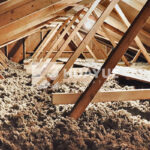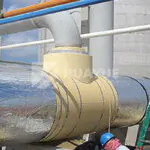








Corrosive vapors, high heat, and humidity break down ordinary insulation. Process lines need stable λ-value and reliable water vapor barriers. Failures cost more than just energy.
Foil faced rock wool delivers λ = 0.033–0.040 W/m·K at 10°C, resists 250–650°C, and meets Euroclass A1. Its reinforced aluminum foil facing stops vapor and boosts mechanical durability.
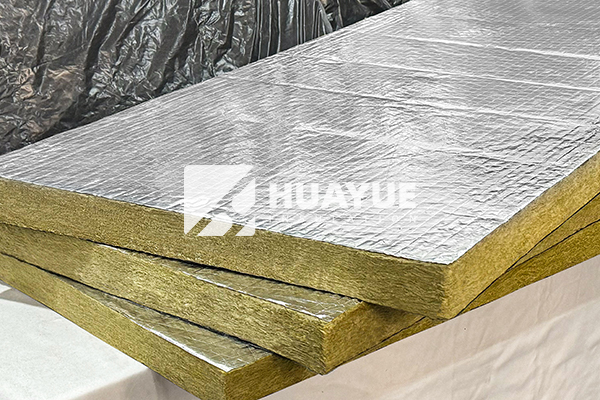
Process lines in chemical plants often face temperature spikes, chemical vapor, and water ingress. Hans, you need insulation that maintains declared λ-value even under cycles. Next, we examine how foil facing changes rock wool’s performance and what that means for installation reliability.
What is the purpose of foil faced insulation?
Corrosive gas and water vapor can breach bare mineral wool, causing λ-value drift and corrosion under insulation. Many sites lack proper vapor control.
Foil faced insulation provides a water vapor diffusion resistance (μ) up to 10,000. In our tests, rock wool bonded to reinforced aluminum foil blocks >99% vapor transmission (per EN 12086).
How foil facing upgrades performance
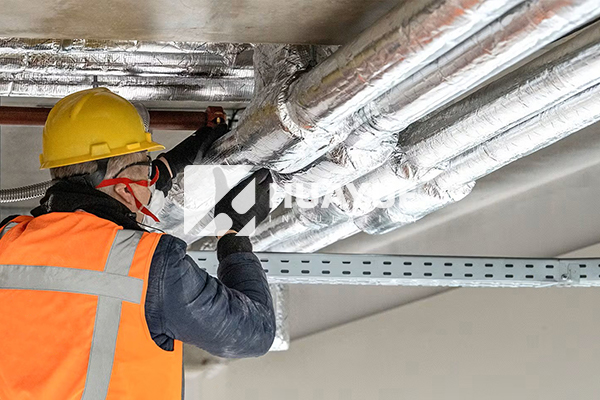
- Vapor barrier: The aluminum foil layer acts as a continuous vapor barrier. This is critical in ammonia, chlorine, or glycol lines, where even trace vapor ingress accelerates under-insulation corrosion.
- Temperature stability: Our foil faced rock wool withstands continuous use from 250°C up to 650°C (depending on thickness and binder type), confirmed by factory test reports per EN 14706.
- Mechanical protection: The foil adds surface durability. In impact or abrasion-prone areas, foil prevents fiber pull-out and dusting.
- Fire safety: Core rock wool achieves Euroclass A1 (EN 13501-1). The foil, <0.05 mm thick, does not downgrade fire rating.
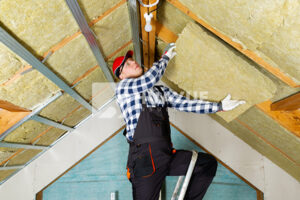
- Installation marking: Facing improves cut line visibility and seam sealing. Joints are taped with aluminum tape (μ > 10,000), ensuring full envelope performance.
Key spec table:
| Property | Value/Standard |
|---|---|
| λ (10°C), W/m·K | 0.033–0.040 |
| Facing vapor resistance μ | Up to 10,000 (EN 12086) |
| Max service temperature | 250–650°C |
| Fire class | Euroclass A1 (EN 13501-1) |
| Density | 40–120 kg/m³ |
Is foil insulation better than ROCK WOOL?
Specifiers often ask if foil facing alone is enough for harsh process environments. Some vendors claim foil is a substitute for mineral insulation.
Foil insulation alone (multi-foil or bubble foil) has λ = 0.040–0.050 W/m·K and resists up to 80°C. Rock wool (with or without foil) handles 250–650°C and offers A1 fire safety.
Foil only vs. foil faced rock wool
| Property | Foil Only (multi-foil) | Foil Faced Rock Wool |
|---|---|---|
| λ (10°C), W/m·K | 0.040–0.050 | 0.033–0.040 |
| Max temperature, °C | 80 | 250–650 |
| Fire classification | E (flammable) | A1 (non-combustible) |
| Compressive strength | Low | 20–70 kPa |
| Standard compliance | EN 13984 (vapor barriers) | EN 13162, DIN 4102 |
Foil insulation alone is only for low-temperature, non-critical use (e.g., residential lofts). It does not meet industrial fire, compression, or λ-value requirements. Foil faced rock wool combines high-temperature stability and fire safety with vapor control. Our factory tests show less than 2% λ-value drift after 1,000 hours at 90% RH, 40°C, per EN 12667.
What is the downside of ROCK WOOL?
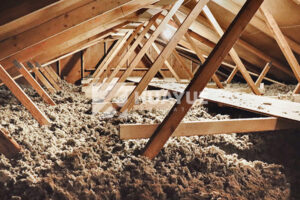
Bare rock wool absorbs water and allows vapor ingress. Over time, this raises λ-value, reduces fire resistance, and risks under-insulation corrosion. Many engineers have seen rapid degradation in unprotected rock wool systems.
Unfaced rock wool has water absorption up to 1.0 kg/m² (EN 1609), and a vapor resistance μ of only 1.5–2.0. λ-value increases by 20–30% in high humidity.
Key limitations
- Moisture uptake: Bare fibers wick water. In process plants, this is a root cause of insulation failure.
- Vapor permeability: No real barrier. Even with cladding, seams and punctures allow vapor transmission.
- Mechanical vulnerability: Exposed fibers can break under impact, leading to settling, dusting, and λ-value drift.
- Cost of repairs: Once wet, rock wool loses thermal performance and must be replaced.
How we address this: At HUAYUE, all foil faced rock wool products undergo accelerated aging and water vapor tests. We report both initial and aged λ-values, with full data sheets available. Our foil faced boards, for example, exhibit <0.02 kg/m² water absorption after 24 hours.
Does ROCK WOOL have faced insulation?
Many engineers assume rock wool is only available unfaced. In fact, facing options are broad, each affecting performance.
Yes, rock wool is produced with factory-applied facings: reinforced aluminum foil (for vapor barrier), glass tissue (mechanical), and black veil (UV). Our foil faced rock wool range: 20–120 mm thick, CE marked.
Common facing types
- Reinforced aluminum foil (ALU): Most effective for vapor barrier. Used in process pipe, vessel, and HVAC insulation. Water vapor resistance μ = 10,000.
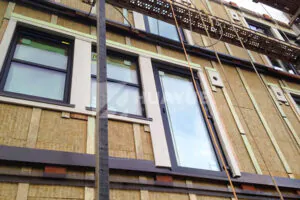
- Glass tissue (VGT): Adds mechanical strength, no vapor barrier. Used in external wall or roof insulation.
- Black veil (BVL): UV protection for exposed surfaces.
- Bitumen kraft (BK): Used in some sandwich panels.
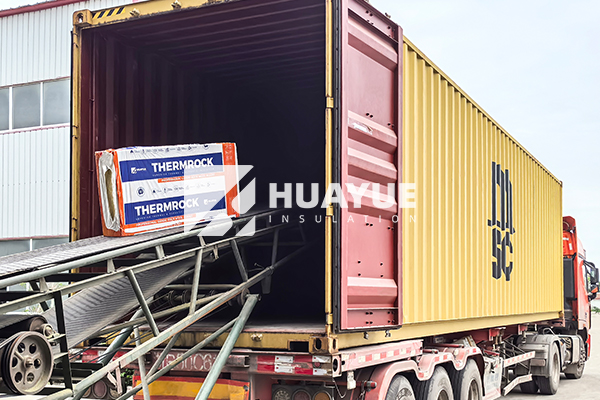
HUAYUE foil faced rock wool: We supply boards, pipe sections, and rolls, all EN 13162 and DIN 4102 compliant. Each batch is tested for face adhesion (min. 100 N/m). CE marking and DoP documents are available for each product code.
Does foil insulation need an air gap?
Incorrect installation can defeat the vapor barrier. Some engineers ask if an air gap is needed to maximize performance.
For process insulation, no air gap is required. Foil faced rock wool must be installed tightly, with all seams sealed using aluminum tape (μ > 10,000) to ensure continuous vapor barrier.
Installation guidelines
- Fit insulation tightly: Boards or pipe sections must be pressed together to minimize gaps.
- Seal all joints: Use 75–100 mm wide aluminum tape (EN 12086 μ > 10,000) at every seam and penetration.
- Check for punctures: Any damage to the foil must be repaired with tape. Gaps or holes void the vapor barrier.
- No air gap for process lines: For industrial insulation, an air gap increases the risk of vapor condensation and migration. Direct application is best.
- Cladding over insulation: In outdoor or mechanical areas, add metal jacketing for impact and weather protection.
Our field tests confirm that properly taped foil faced rock wool systems maintain <1 g/m²·day vapor transmission, even after thermal cycling. Always follow EN 14303 and site QA protocols for compliance.
Conclusion
Foil faced rock wool combines λ = 0.033–0.040 W/m·K, Euroclass A1, and μ = 10,000 vapor resistance. For chemical plants, this means stable performance and certified compliance under real process conditions.