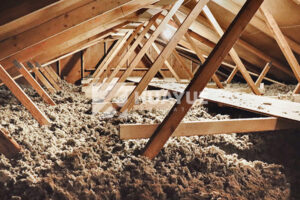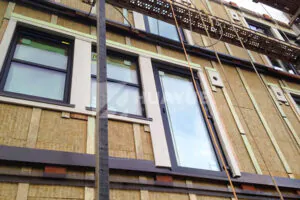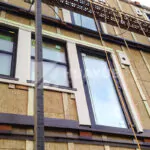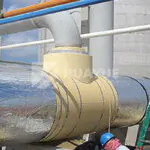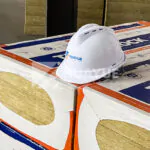








A rock wool acoustic panel is a porous mineral-fiber panel used to absorb reflected sound in rooms or as part of a wall, ceiling, or enclosure assembly.
Rock wool acoustic panels can reduce echo and improve room sound quality by absorbing part of the sound energy that reaches their surface. They do not, by themselves, make a wall or room soundproof; isolation also depends on the complete construction, sealing, and sound path.
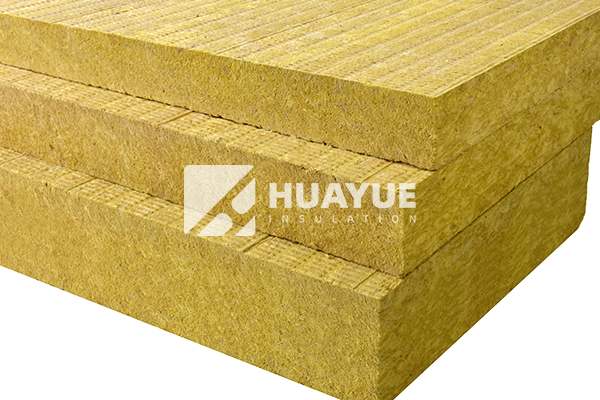
The useful question is not only whether rock wool absorbs sound, but what the panel is expected to control, where it will be installed, and what evidence supports the proposed construction.
What Is a Rock Wool Acoustic Panel?
A rock wool acoustic panel combines a rock wool core with a supporting frame, facing, cover, or mounting system selected for the intended acoustic use.
The term “rock wool acoustic panel” may describe a rock wool board used inside a construction or a finished room-treatment panel made from several components. Confirm the exact product form before comparing offers.
Rock wool, also called stone wool, is a fibrous mineral material. In an acoustic panel, the core is normally positioned so that sound can reach the porous structure rather than simply bounce from a hard, sealed surface. The panel may be exposed behind a suitable cover, installed within a frame, fixed to a wall or ceiling, or placed inside a cavity. These configurations are not interchangeable: the cover, backing, mounting depth, air space, and amount of treated surface can all change the acoustic result.
This distinction matters because “panel” is used broadly in product searches. It can mean a rigid board, a semi-rigid infill, a fabric-wrapped absorber, a ceiling element, a baffle, or a component in a partition or equipment enclosure. A product title alone does not tell a buyer whether the item is intended for room absorption, cavity insulation, sound isolation, or another use.
Spanish-language searches may use <code>paneles acusticos lana de roca</code>, <code>paneles acústicos de lana de roca</code>, or simply <code>lana de roca</code>. These phrases describe the same material family, but the buyer still needs to confirm the panel construction, surface treatment, and installation method.
For a B2B project, ask for the exact product name, form, thickness, facing or cover, mounting detail, and applicable acoustic documentation. If the panel is only the core of a larger assembly, keep the product claim separate from the performance of the completed wall, ceiling, floor, or enclosure.
How Does a Rock Wool Acoustic Panel Improve Noise Control?
A rock wool acoustic panel improves noise control mainly by reducing reflected sound and reverberation; it contributes to isolation only when it is used within a suitable complete assembly.
Absorption and sound isolation solve related but different problems. A panel can make a room less reverberant and speech easier to understand, while a sealed, mass-and-connection-controlled construction is needed to limit sound transmission between spaces.
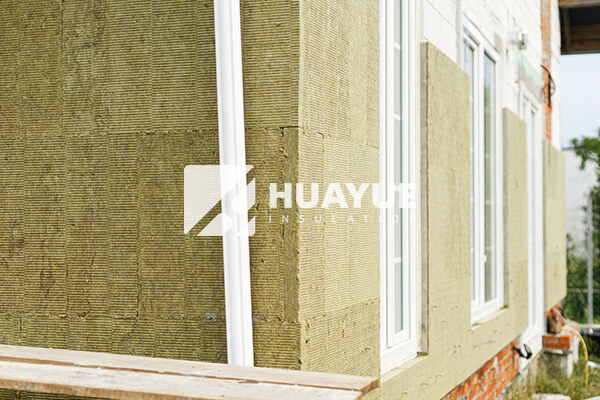
When sound reaches a porous fibrous surface, part of its energy is dissipated within the material rather than returning to the room as a strong reflection. That is the basic reason an acoustic panel can help control echo, reverberation, and the build-up of ambient sound. The U.S. Federal Highway Administration defines absorption as the dissipation of noise energy at porous surfaces and distinguishes it from attenuation and transmission ratings in its noise glossary.
The result is a change in the room’s sound field, not necessarily a large reduction in the sound produced by the source. A meeting room may feel quieter because voices reflect less. An equipment area may become easier to work in because reverberant energy is reduced. A studio or classroom may benefit from better speech or audio clarity. These are room-acoustic outcomes.
Sound isolation is different. If the buyer wants to stop noise from passing from one room to another, the panel is only one layer of the solution. The wall or ceiling may also need appropriate mass, an air cavity, resilient connections, continuous joints, sealed perimeters, and coordinated treatment of doors, windows, ducts, services, and other penetrations. FHWA guidance describes these construction factors together and notes that cracks and edges can undermine an otherwise well-designed wall. Its construction guidance also identifies mineral or rock wool blankets as one possible component within a wall cavity, not as a universal stand-alone rating.
This is why “noise control” is a safer and more useful term than promising that any rock wool panel will “block all noise.” The panel may be appropriate for absorption, cavity damping, or a specified assembly, but the correct role depends on the sound path and the design objective.
Where Are Rock Wool Acoustic Panels Used?
Rock wool acoustic panels are used where a project needs sound absorption, cavity treatment, or a mineral-fiber component inside a broader noise-control system.
Typical uses include interior room treatment, partitions and ceilings, equipment-room enclosures, and selected industrial or commercial assemblies. The correct form depends on whether the priority is reverberation, airborne transmission, impact noise, vibration, or a combination.
The following distinction helps prevent a common specification error: selecting a visible acoustic panel when the real problem is sound travelling through a wall, floor, duct, or machine support.
| Project situation | What a rock wool acoustic panel may contribute | What still needs separate review |
|---|---|---|
| Office, meeting room, classroom, or studio | Absorption of reflected sound on walls or ceilings | Room layout, coverage, mounting, and the target frequency range |
| Partition or ceiling cavity | A porous layer within the cavity that supports the assembly’s acoustic design | Wall or ceiling layers, framing, joints, penetrations, and perimeter sealing |
| Equipment room or plant enclosure | Absorption or lining where the enclosure is designed for noise control | Source vibration, structure-borne paths, access panels, ventilation, and worker safety |
| Floor or impact-noise condition | A possible component where the specified system addresses impact transmission | Resilient layers, structural connections, floor finish, and the complete tested assembly |
For exposed room panels, the cover should allow the intended acoustic interaction with the core and should suit the environment. A decorative, airtight, or rigid surface can change how the panel behaves. For cavity applications, continuity and fit matter: gaps, compression, bypasses, and unsealed edges can reduce the value of the installed layer.
Rock wool panels are not a universal answer for every noise problem. Very low-frequency sound, vibration transmitted through machinery or structure, impact noise, and noise leaking through doors or openings may require isolation, decoupling, added mass, resilient supports, sealing, or a separate acoustic design. A project involving fire, moisture, hygiene, mechanical loading, outdoor exposure, or operating temperature should also verify those requirements independently. Acoustic suitability does not automatically prove every other product property.
What Should Buyers Check Before Specifying a Rock Wool Acoustic Panel?
Buyers should compare the acoustic objective, product form, installation conditions, and evidence scope before approving a rock wool acoustic panel for a project.
A reliable specification connects the panel to its intended use: room absorption, cavity treatment, or a complete isolation assembly. It should also identify the mounting condition and keep any rating tied to the tested product or construction.
A practical pre-purchase check
Start with the sound source and receiver. Describe whether the concern is echo inside one room, speech privacy between rooms, machinery noise, traffic noise, impact noise, or vibration. Then identify the construction: wall, ceiling, floor, enclosure, duct lining, or freestanding panel. This prevents a room absorber from being treated as a complete sound-isolation barrier.
Next, request comparable information for the proposed product and installation. The review should normally cover:
- product form: board, panel, batt, blanket, baffle, or a composite finished panel;
- core thickness, dimensions, facing or cover, and support method;
- whether the panel is exposed, backed, mounted with an air space, or installed in a cavity;
- frequency-dependent absorption information where room treatment is the objective;
- the test method, sample mounting, frequency range, and conditions behind any acoustic value;
- the complete assembly description when the required outcome is wall, ceiling, floor, or enclosure isolation;
- installation details for joints, edges, penetrations, services, and ventilation;
- separate documentation for fire, moisture, mechanical, hygiene, or temperature requirements.
Do not turn density into a universal acoustic score. Density may help identify a product grade or match a particular test sample, but thickness, fiber structure, airflow behavior, mounting, facing, air space, and the surrounding construction also influence the result. A higher number is not automatically the correct choice for every panel or assembly.
The SinoInsulation rock wool insulation product range can be used as a starting point for identifying available product forms. For deeper sound-isolation selection, link this article to the related guide on choosing rock wool for soundproofing, which addresses the distinction between a material component and a complete acoustic construction.
For an initial supplier discussion, the application and approximate construction depth are usually enough to start. Drawings, target performance, dimensions, quantity, destination, facing, packaging, and required documents can follow once the acoustic task and product form are clear.
Conclusion
Rock wool acoustic panels reduce reverberation, but the final result depends on the complete assembly. Share your application and construction depth for a focused product review.