







Rock wool can help with sound control, but the best result depends on the noise path, wall construction, and how the material is installed.
Yes, rock wool can support soundproofing—but mainly as a porous absorber or cavity layer. It does not block every noise source by itself; mass, air sealing, decoupling, and installation determine the finished wall result.
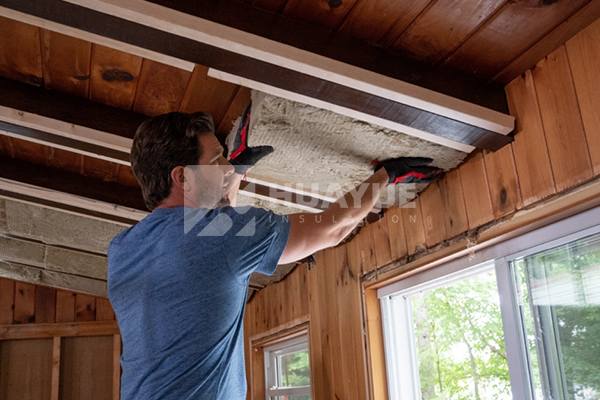
This guide explains what rock wool and mineral wool can do, which low-cost wall measures come first, why rodents are not a selection guarantee, and how to handle the material safely.
Is Rock Wool Good for Soundproofing?
Rock wool can be useful for sound control, but “soundproofing” describes more than one acoustic task.
Rock wool can absorb part of the sound energy in a room or cavity and can support a wall or ceiling assembly. It cannot make a poorly sealed construction soundproof on its own.
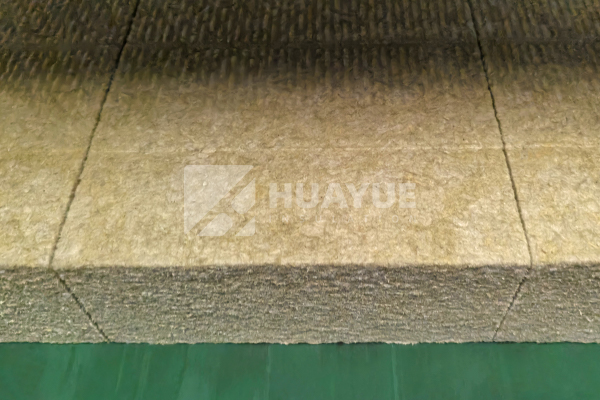
The first distinction is between sound absorption and sound isolation. Absorption reduces reflected sound and reverberation inside a room, enclosure, or cavity. Isolation, sometimes described through transmission loss or a rating for a complete construction, limits sound passing from one space to another. A porous mineral-fiber layer can help with the first task and can be one component of the second, but the two results are not interchangeable.
The OSHA Technical Manual explains that sound-absorbing materials reduce reverberant buildup, while sound-transmission-loss materials, barriers, enclosures, and construction details address sound travelling through a structure. That distinction matters when a buyer is comparing a visible acoustic panel with insulation inside a partition.
For room treatment, the relevant questions may include the panel thickness, exposed surface, cover, mounting depth, air gap, treated area, and frequency range. A panel that reduces echo can make speech or equipment noise feel less harsh without substantially stopping sound from entering or leaving the room.
For a wall between rooms, rock wool is only one layer. The result also depends on the board or lining layers, framing, cavity depth, resilient connections, perimeter sealing, doors, glazing, service penetrations, junctions, and flanking paths. A small opening or rigid bridge can bypass an otherwise continuous insulation layer. Low-frequency music, impact noise, vibration and structure-borne machinery noise may require added mass, decoupling, resilient supports, damping or source control as well.
Keep the evidence at the same scope as the claim:
| Acoustic question | Useful evidence | What it does not prove |
|---|---|---|
| Will a room treatment reduce echo? | Frequency-dependent absorption data for the product and mounting condition | Sound isolation through a wall |
| Will a cavity layer support a partition? | Complete wall or ceiling construction and its tested or engineered acoustic basis | A universal rating for every rock wool board or batt |
| Will a machine room become quieter? | Source, enclosure, vibration and transmission-path design | That insulation alone controls structure-borne noise |
So, rock wool is good for soundproofing when its role is defined correctly. Choose it as part of a documented acoustic solution, not as a substitute for the complete construction.
Is Mineral Wool Good for Soundproofing?
Mineral wool can be a good sound-control material, but the term covers a broader family than rock wool.
Mineral wool is a broad mineral-fiber category that can include rock wool and slag wool. It can support sound absorption and cavity treatment, but the exact product form, test condition and surrounding assembly still control the result.
The wording matters in a quotation. Rock wool, also called stone wool, is one mineral-wool route. “Mineral wool” may be used more broadly, so a buyer should ask whether the offer is a rock wool board, a rock wool batt, a blanket, a finished acoustic panel, or another mineral-fiber product. These forms are not automatically interchangeable for thickness, support, facing, mounting or acoustic evidence.
The U.S. Department of Energy insulation guide treats mineral wool as an insulation option with sound-insulation value while also noting that installation affects performance. The useful takeaway is not that every mineral-wool product has one universal rating. It is that the material family can be relevant, while the named product and installed construction must still be checked.
Compare candidate products on an equivalent basis. Record the intended use, product form, thickness, dimensions, cavity depth, facing or cover, mounting, air gap, frequency range, test method and product identity. For a wall or ceiling, request the complete assembly description instead of using a material absorption value as a substitute for a wall-transmission result. For a room absorber, confirm that the cover and mounting allow the porous surface to perform as intended.
Do not use density as a shortcut for “best.” Density may be relevant to a particular product grade, fit, support requirement or test sample, but a higher number does not automatically solve every frequency range or every noise path. A thinner dense board, a thicker batt, and a finished panel may have different acoustic roles even when all are called mineral wool.
There is also a brand distinction. <code>ROCKWOOL</code> in uppercase identifies an unaffiliated manufacturer and brand; it is not a generic name for all rock wool. Compare a named competitor product only within its own documents, and do not transfer its performance, approval or suitability to a SinoInsulation or HUAYUE offer. For broad product-form routing, see the rock wool insulation range and then request the current document for the proposed form.
What Is the Cheapest Way to Reduce Noise Through Walls?
The lowest-cost useful step depends on the existing wall, the source of the noise and whether the construction can be opened.
Usually, start by finding and sealing sound leaks, then add practical mass or cavity treatment. Do not spend first on acoustic foam if the problem is noise passing through a wall.
Use this sequence before buying a specialist soundproofing product:
- Identify the path. Decide whether the problem is voices through a shared wall, room echo, footsteps, machinery vibration, a door gap, a duct or another flanking route. A cheap treatment for echo will not necessarily reduce sound transmitted through a partition.
- Seal accessible leaks. Check the wall-to-floor and wall-to-ceiling edges, door perimeter, outlet and switch boxes, service penetrations and visible cracks. Use compatible sealants, gaskets or rated details where appropriate, and do not block required ventilation or compromise a fire-rated penetration.
- Add mass using what already exists. A full bookcase, wardrobe or other heavy furniture against a shared wall may change the sound path at little or no material cost. Keep expectations realistic: this is a practical reduction measure, not a tested wall rating.
- If the wall is open, improve the cavity. A correctly fitted mineral-wool layer can reduce cavity resonance and support the wall design. It still needs continuous coverage, the correct depth, suitable board layers and sealed edges. Do not leave voids or compress a product outside its installation guidance.
- Escalate when the path requires it. Persistent bass, impact noise, vibration or strong speech transmission may need additional mass, damping, decoupling, resilient connections or a designed enclosure. These measures cost more because they change the construction rather than only treating the room surface.
Foam panels, thin decorative panels and soft furnishings can reduce reflection inside the receiving room. They are useful when the room sounds hard or reverberant, but they are not a substitute for mass, separation and airtightness when the complaint is a neighbour’s voice or equipment noise through a wall.
For a building or industrial project, the cheapest correct route is the one that fixes the dominant path without creating a second problem. Send the source, receiver, wall or enclosure type and approximate construction depth before comparing rock wool forms or acoustic documents. That information is more useful than asking for the “highest-density” insulation first.
Do Mice Hate Rock Wool Board Insulation?
Rock wool board may be less attractive to rodents than some softer materials, but it should not be treated as a mouse barrier.
No reliable product rule says mice hate rock wool. Mineral wool may offer some pest resistance, yet mice can still enter, tunnel through or damage insulation when access and nesting conditions are available.
The DOE insulation guide describes mineral wool as resistant to pests, which is useful when comparing broad material characteristics. That wording does not mean rodents cannot reach it or that a board will stop an infestation. Rodents can move through openings around the insulation, behind boards, along services or through adjacent materials.
The University of Nebraska-Lincoln study found that house mice caused damage and increased thermal conductance in wall panels insulated with several materials, including rockwool. The study is older and does not predict the behavior of every current product, but it clearly supports one practical conclusion: no insulation should be marketed or specified as mouse-proof without product- and assembly-specific evidence.
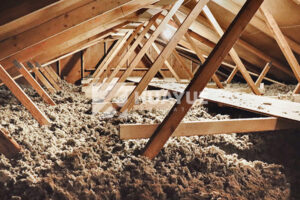
Use rock wool as one part of a rodent-control strategy, not as the exclusion layer. Inspect foundations, wall edges, service openings, vents, doors and roof interfaces. Close entry points with materials suited to rodent exclusion, such as metal mesh, sheet metal or masonry details where the construction requires them. Protect the insulation from water, contamination and displacement, and replace or assess material that has been damaged by urine, droppings or nesting.
For a supplier comparison, ask whether the proposed board or batt is intended for the application and how its edges, joints, supports and adjacent penetrations will be protected. “Mice hate it” is not a technical specification. The more useful question is whether the complete building detail prevents entry and preserves the insulation’s installed position.
Can You Touch Rock Wool With Bare Hands?
Brief contact may be physically possible, but bare-hand handling is not a recommended work practice.
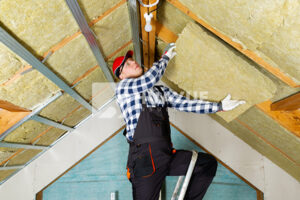
Avoid direct skin contact with unwrapped rock wool. Wear gloves, long sleeves and suitable eye or respiratory protection for the task, and follow the exact product SDS or safe-use sheet.
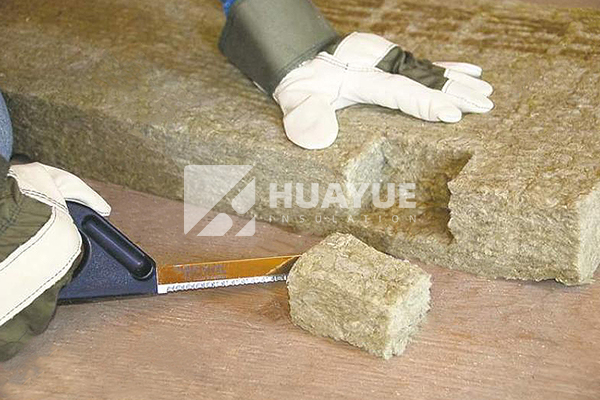
Rock wool fibers and dust can cause mechanical skin or upper-respiratory irritation during handling, cutting and cleanup. The Insulation Institute’s safe-handling guidance recommends gloves and loose-fitting long-sleeved and long-legged clothing for work involving fiberglass, rock wool and slag wool. It also recommends controlling dust, using appropriate eye protection when needed and avoiding compressed air for cleanup.
The risk is highest when the product is being cut, trimmed, moved overhead or disturbed after installation. Keep the material packaged until it is needed, use a low-dust cutting method, provide ventilation and collect scraps rather than sweeping or blowing fibers through the work area. PPE does not replace the product’s own safety instructions; an SDS or safe-use sheet should control the handling method for the exact board, batt or blanket being supplied.
If fibers get onto the skin, do not rub or scratch. Follow the product instructions for removal, clean contaminated clothing as directed and seek medical advice if irritation continues. If dust enters the eyes, do not rub them; flush with clean water and obtain medical attention if symptoms persist. Workplaces should also apply their local occupational-safety requirements, especially for repeated fabrication or enclosed-space work.
This handling advice is compatible with using rock wool in acoustic construction, but it is still part of product selection. Consider whether the material will be exposed, enclosed behind a finish, cut repeatedly, accessed for maintenance or installed above workers. The product form, facing, support and enclosure should protect the intended performance while keeping installation practical and controlled.
Conclusion
Choose rock wool by acoustic task, complete assembly, rodent exclusion and safe handling. Share the application and approximate construction depth with the SinoInsulation team for product review.