







Stone wool pipe insulation can suit demanding pipework, but only when the product and complete insulation system match the service conditions.
Choose a preformed rock wool pipe section when its documented temperature range, thermal data, dimensions, moisture protection, and project approvals fit the line. For below-ambient or persistently wet service, compare complete systems—not material names—before deciding.
This guide explains what the product is, where it deserves consideration, when another material may fit better, and what buyers should specify before ordering.
What Is Stone Wool Pipe Insulation?
The product form matters because a purpose-made pipe section and a blanket wrapped around a pipe are not the same specification.
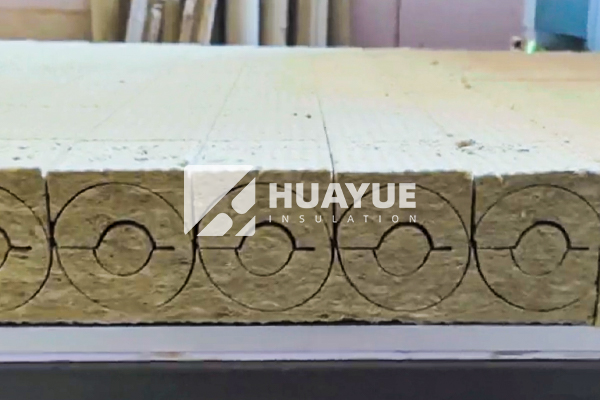
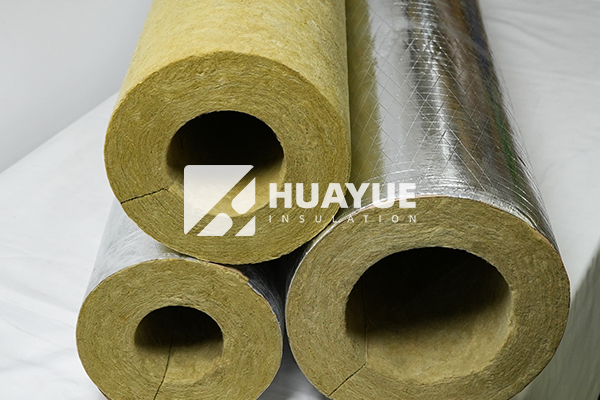
Stone wool pipe insulation is mineral-fiber insulation formed around standard pipe geometry, commonly as split hollow sections. Rock wool and stone wool are generic material terms; ROCKWOOL is an unrelated manufacturer brand, not a SinoInsulation or HUAYUE brand.
ASTM C547-25 defines mineral-fiber pipe insulation as hollow cylinders made for standard pipe and tubing sizes. Its scope includes molded or precision V-grooved products split longitudinally. It also draws an important boundary: flexible mineral-fiber wraps, manually scored boards, and flexible boards or blankets used around pipes are not covered by that pipe-section specification.
That distinction prevents a common purchasing error. A quotation for “rockwool insulation for pipes” may refer to a preformed pipe section, a roll cut and wrapped on site, or a fabricated component for an elbow or fitting. These options differ in fit, joint pattern, installation time, support, outer protection, and the evidence needed for approval. They should not be compared by density or price alone.
Terminology can also blur the product scope. Mineral fiber is a wider category that may include fibers made from rock, slag, or glass. Stone wool and rock wool usually describe the rock-based material subtype, while lowercase “rockwool” is often used loosely in searches. A technical submittal should therefore use the exact manufacturer, product name, form, dimensions, facing or jacket, and applicable test evidence rather than relying on a generic or brand-like keyword.
For initial product routing, the SinoInsulation rock wool product overview confirms that pipe is one available form. Exact values still need the current named-product documents and project review.
When Is a Rock Wool Pipe a Strong Candidate?
Rock wool deserves consideration when the pipe service needs a preformed mineral-fiber section and the complete system can remain protected and maintainable.
A rock wool pipe section is a strong candidate when verified product data fits the operating temperature and thermal objective, the section matches the pipe, and suitable joint, support, jacketing, moisture-control, and inspection details can be provided.
| Project condition | Why rock wool may enter the shortlist | What must still be verified |
|---|---|---|
| Hot-water, steam, or process line | A preformed mineral-fiber section can provide continuous thermal coverage around the cylindrical surface | Named-product service range, thermal data at relevant mean temperatures, thickness calculation, joint treatment and outer protection |
| Mechanical or HVAC pipework | Standardized pipe geometry can make a split section easier to fit consistently than field-cut flat material | Pipe outside diameter, insulation inside diameter, available clearance, fittings and support details |
| Fire-sensitive area | Mineral-fiber pipe insulation may offer relevant tested fire properties | Exact product, facing, jacket, test method, classification and installed-system requirement |
| Noisy line or equipment connection | Acoustic performance may be a secondary selection objective | Whether the tested product and complete enclosure address the actual airborne or structure-borne noise path |
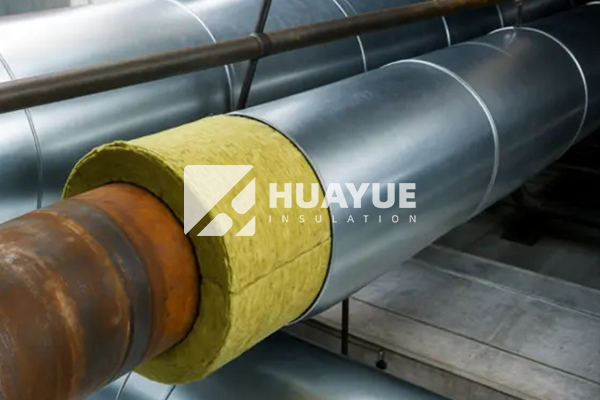
| Indoor or outdoor industrial service | A protected pipe section can be integrated into a designed insulation system | Weather exposure, mechanical abuse, chemicals, washdown, jacketing, terminations and inspection access |
The main value is not that rock wool “wins” every row. It is that the form can be evaluated against a clear set of requirements. For hot services, the review normally starts with heat conservation, process control, surface temperature, personnel protection, fire requirements, and the allowable temperature for every component—not only the fiber core. A facing, adhesive, tape, coating, support or jacket can have a different limit.
For steam distribution and condensate return lines, the U.S. Department of Energy recommends insulating exposed hot surfaces and addressing wet or damaged insulation. That is a general reason to insulate; it is not proof that one stone wool product, thickness, or jacket suits every line. The project calculation and named documents still control the choice.
Installation quality also changes the result. Straight sections are only part of the system. Elbows, tees, valves, flanges, hangers, penetrations and removable covers can create discontinuities. A candidate material should therefore be judged by the complete bill of materials and maintainable detail set, not by a straight-pipe sample alone.
When Should You Compare Another Pipe Insulation?
The better question is not whether stone wool is good, but whether another complete system manages the dominant project risk more directly.
Compare other pipe-insulation systems when condensation control, very low temperature, liquid-water exposure, tight clearance, complex geometry, frequent maintenance, chemical compatibility, or a project-specific approval outweighs the advantages of a preformed rock wool section.
Use the dominant design objective to decide where comparison is necessary:
| Decision trigger | Comparison question |
|---|---|
| Below-ambient or chilled service | Which named system provides the required thermal thickness and a continuous, repairable vapor-control strategy at seams, fittings, supports and terminations? |
| Outdoor, washdown or splash exposure | Which insulation, jacket and sealing system can manage expected water, UV, wind and mechanical damage while remaining inspectable? |
| Cryogenic or unusually low-temperature duty | Which complete system has evidence for the exact temperature range, vapor pressure, contraction, joints and cycling conditions? |
| Congested pipe rack or irregular equipment | Can the required thickness, outer diameter, fitting geometry and maintenance clearance be installed without unsafe compression or inaccessible joints? |
| Frequent valve or flange access | Can removable insulation and jacketing be opened and restored without leaving moisture paths or thermal gaps? |
| Stainless or corrosion-sensitive piping | What pipe coating, insulation chemistry, barrier, drainage, inspection and CUI-management requirements does the owner specify? |
| Fire or code-critical assembly | Does the named product and complete installed system have the exact test or approval required by the authority or project? |
This approach avoids a misleading rock wool-versus-fiberglass-versus-foam ranking. Each material family contains products with different formulations, temperature ranges, vapor properties, fire results, dimensions and accessories. A flexible closed-cell material may simplify vapor control on some chilled lines, yet its temperature or fire evidence may not fit a hot process line. A rigid closed-cell material may be considered where moisture or load resistance is decisive, but its joints, cost, fabrication and system approvals still require review. Fibrous pipe sections may suit many hot services, while exposed or cold duties still need compatible protection.
The substitution test should compare the same design conditions: pipe size, operating and ambient temperatures, humidity, location, thermal objective, surface-temperature limit, fire requirement, expected water, pipe material, support detail, maintenance plan and service life assumptions. Comparing only nominal conductivity, density or price per cubic meter hides the conditions that usually cause failure.
How Do Moisture and CUI Change the Decision?
Moisture is a system problem, and no generic insulation name can guarantee that the pipe beneath it will remain dry or corrosion-free.
For below-ambient pipework, design separately for outer-surface condensation and water-vapor intrusion. For any CUI-sensitive line, coordinate pipe protection, insulation, vapor or weather barriers, jacketing, sealed details, drainage, inspection and repair. Rock wool alone does not prevent CUI.
The National Insulation Association Mechanical Insulation Design Guide separates two below-ambient objectives. First, the outer surface of the insulation system should remain above the surrounding air’s dew point under the chosen design conditions. Second, water vapor must be prevented or managed so it does not move through gaps or materials and condense at the colder pipe surface. More insulation thickness may improve surface temperature, but thickness alone does not seal seams or stop vapor intrusion.
ASTM C547-25 likewise calls for properly installed protective vapor retarders or barriers in sub-ambient applications within its scope. The practical word is “system.” Longitudinal seams, butt joints, elbows, valves, hangers, terminations and maintenance openings must be designed so the vapor-control layer remains continuous and can be repaired after inspection. A foil facing on a product does not automatically prove that every joint and penetration forms a complete vapor barrier.
For above-ambient outdoor lines, the moisture route may be rain, washdown, leakage or damaged jacketing rather than inward vapor drive. The project still needs suitable weather protection, sealed overlaps, end details, drainage logic and inspection access. Wet insulation should trigger investigation of the moisture source and the pipe condition; simply covering it with new jacketing can conceal an active problem.
CUI risk also depends on pipe material, surface preparation or coating, contaminants, operating temperature and cycling, shutdown periods, water chemistry and inspection strategy. Buyers should ask the project engineer or asset owner for the applicable CUI specification. A low water-sorption test result for one insulation sample is not a guarantee that an installed pipe system cannot admit water or corrode.
What Should Buyers Specify Before Ordering?
A usable request for quotation describes the pipe service and the complete insulation system instead of asking only for “rock wool pipe” and a thickness.
Start with the pipe service and operating temperature. Then add pipe size, ambient conditions, design objective, location, insulation thickness method, jacket or vapor-control requirements, fittings, supports, quantities, and the exact documents needed for technical approval.
| RFQ field | Information to provide or verify | Why it changes the selection |
|---|---|---|
| Service and operating range | Medium in the pipe; normal, start-up, upset and shutdown temperatures where relevant | Establishes the thermal and component temperature envelope |
| Pipe identity and geometry | Pipe material, nominal size or outside diameter, straight length, elbows, tees, valves, flanges and equipment connections | Determines inside diameter, fabrication, joints, fitting covers and quantities |
| Environment | Indoor/outdoor, ambient temperature, relative humidity, wind, washdown, splash, UV, chemicals and mechanical exposure | Drives condensation, weather protection, compatibility and jacketing decisions |
| Design objective | Heat conservation, process control, condensation control, freeze protection, personnel protection, acoustic control or fire requirement | Defines the calculation and evidence needed |
| Thickness basis | Local code, project specification, heat-loss target, surface-temperature target or condensation calculation | Prevents a generic thickness table from replacing the design |
| Complete system | Insulation form, facing, vapor retarder, weather barrier, metal or other jacket, bands, sealants, supports and removable covers | Makes component limits and joint continuity reviewable |
| Technical evidence | Current named-product data sheet, thermal data with test conditions, applicable test reports, SDS, installation instructions and required approvals | Connects each public or supplier claim to the product being offered |
| Commercial scope | Quantity, destination, packing, labeling, inspection and document language | Makes quotations comparable after technical suitability is established |
Use the rock wool specification guide to check how product identity, form, dimensions, density, thermal data, test conditions, facing and application should be recorded. For pipe sections, add the insulation inside diameter and the fitting schedule; these fields are essential to fit and coverage.
Do not approve a substitution because the proposed product has a similar density or a lower declared conductivity on a single line of a data sheet. Confirm that the value uses compatible units, test methods and mean temperatures, then check the product form, use-temperature evidence, facing or jacket limits, moisture strategy, fire scope and local approval. Ask how bends, valves, supports and terminations will be treated, because those details often carry more installation risk than the center of a straight section.
Handling should also be planned from the current safety data sheet and site controls. The OSHA synthetic mineral fibers page records occupational exposure limits for mineral-wool fibers and dust. The installer should follow the product SDS, cutting method, ventilation, housekeeping and required protective equipment rather than relying on a generic instruction copied from another product.
Conclusion
Choose stone wool pipe insulation by service conditions and system evidence, not the material name alone. Share the pipe service and operating temperature to begin a focused review.