







R13 mineral wool insulation is a thermal-resistance rating, not a separate material category.
For North American cavity applications, R-13 mineral wool is commonly a 3.5-inch batt intended for a nominal 2×4 wall cavity, but exact dimensions and product data belong to the named manufacturer.
This guide explains the R13 label, its typical fit, how it compares with R15, and what buyers should verify before specifying or ordering it.
How Thick Is R13 Mineral Wool Insulation?
R13 describes thermal resistance; thickness depends on the product form, test basis, and intended assembly.
A current U.S. batt example lists R13 mineral wool at 3.5 inches (89 mm) thick, with widths for 16- and 24-inch-on-center wood framing. Treat this as named-product evidence, not a universal rule.
The official ROCKWOOL Comfortbatt product page lists a U.S. R13 wood-stud product at 3.5 inches thick and 47 inches long. It shows widths of 15.25 inches for 16-inch-on-center framing and 23 inches for 24-inch-on-center framing. These dimensions illustrate the normal North American batt pattern: a product is sized for the cavity depth and framing spacing, not selected from the R-value label alone.
The same product table lists R13 and R15 options at the same 3.5-inch thickness for the named wood-stud product. That matters because buyers sometimes assume that a higher R-value must always mean a thicker batt. In practice, thickness, fiber structure, density, facing, and test conditions are product-specific. A loose-fill or blown mineral wool model may use a different thickness from a pre-cut batt, so a generic “R13 equals X inches” statement can mislead.
| Selection field | R13 batt example | Why it matters |
|---|---|---|
| Thermal label | R13 | States nominal resistance to heat flow |
| Product form | Pre-cut batt | Determines fit and installation method |
| Thickness | 3.5 in (89 mm) | Matches a nominal 2×4 cavity in the named example |
| Framing width | 15.25 or 23 in | Matches 16- or 24-in-on-center wood framing |
| Length | 47 in | Affects coverage, cutting, and pack calculation |
When reviewing another supplier, ask for the exact product name, thickness, width, length, units, and declared R-value on one current document. Do not transfer a competitor’s dimensions to a SinoInsulation or HUAYUE product. If a project uses metric framing, steel studs, boards, blankets, or loose fill, the correct size may be different.
Is R13 Mineral Wool Insulation Suitable for a 2×4 Wall?
The 2×4 question is usually a cavity-fit question first and a code question second.
R13 mineral wool can be a suitable cavity-insulation option for some 2×4 wall assemblies, especially where the selected batt is designed for a 3.5-inch cavity. Local code, climate, framing, and the complete wall assembly still control.
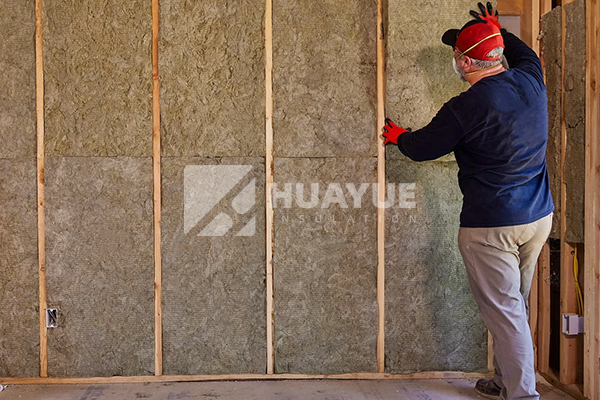
The U.S. Department of Energy summarizes the 2021 IECC wall options and shows R13 as one path for an uninsulated 2×4 wood-frame wall in climate zones 1 and 2. In several colder or more demanding zones, the table uses higher cavity values or combinations such as cavity insulation plus continuous insulation. This is a code-reference example, not permission to assume that R13 satisfies every wall, jurisdiction, or project brief. Check the adopted code and authority having jurisdiction for the actual location.
For a 2×4 wall, confirm four dimensions before ordering:
- The actual cavity depth available after sheathing, services, membranes, and finishes.
- The stud spacing, commonly 16 or 24 inches on center in North American framing.
- The batt width that fits the spacing without leaving side gaps.
- The required cavity R-value and any continuous-insulation layer outside the framing.
The batt R-value is not the R-value of the finished wall. Timber studs, fasteners, sheathing, cladding attachments, electrical openings, air leakage, and thermal bridges affect the assembly. The U.S. Department of Energy’s Building Science Education resource notes that voids, gaps, compression, and misalignment with air barriers can change installed performance. A product can carry an R13 label and still be installed poorly if it is cut short, crushed around services, or interrupted at the perimeter.
R13 also does not define sound transmission, fire-resistance time, vapor control, or moisture safety for the complete wall. Those requirements depend on the tested assembly and project design. Use the thermal label to answer the thermal-resistance question, then review the other performance requirements separately.
What Is the Difference Between R13 and R15 Mineral Wool Insulation?
R13 and R15 are neighboring thermal ratings often considered for the same nominal cavity depth.
R15 provides two R-value points more than R13, or about 15.4% higher nominal material-layer resistance. The better choice depends on the project target and documented fit, not on the label alone.
For a simple label comparison, R15 is greater than R13 because it resists more heat flow under the applicable rating basis. The difference is useful when a specification, energy model, or code path calls for a particular minimum. It is not a guarantee that a finished R15 wall will outperform every R13 wall by exactly 15.4%, because whole-wall results include framing, joints, air barriers, penetrations, and installation quality.
| Question | R13 | R15 |
|---|---|---|
| Nominal thermal label | Lower of the two | Higher of the two |
| Arithmetic difference | — | 2 R-value points above R13 |
| Relative label difference | — | About 15.4% above R13 |
| Named 3.5-inch wood-stud example | Available on the cited U.S. product page | Also available on that page |
| What it does not prove | Whole-wall, acoustic, or fire performance | Whole-wall, acoustic, or fire performance |
Choose R13 when it matches the approved cavity requirement and the selected product is properly sized. Consider R15 when the project allows the same depth and the additional nominal resistance helps meet the target without creating a fit problem. Do not select a deeper product simply because its label is higher if it must be compressed into a shallow cavity. The U.S. Federal Trade Commission explains that R-value information should be based on standard tests and that higher R-value means greater insulating power; the rule does not replace the project’s assembly design or local code review.
Keep terminology precise during procurement. “R13” and “R15” describe thermal resistance; “mineral wool,” “rock wool,” and “stone wool” describe material categories or subtypes; and a brand name identifies a particular manufacturer. Compare the named product documents on the same basis rather than comparing a generic category with a trademark.
Can R13 Mineral Wool Insulation Be Used in a 2×6 Wall?
A 2×6 wall has a deeper nominal cavity than a standard 2×4 wall, so the batt depth must be checked before the R-value label.
R13 mineral wool is usually not the normal stand-alone full-depth batt for a 2×6 cavity. A 3.5-inch R13 batt leaves unused depth in a nominal 5.5-inch cavity unless a designed layered or hybrid assembly addresses the remaining space.
The cited ROCKWOOL product table provides a useful named example: its wood-stud R13 and R15 batts are 3.5 inches thick, while its R21 and R23 wood-stud options are 5.5 inches thick. The table does not make those values universal, but it shows how product lines often align rating, thickness, and cavity depth. For a 2×6 wall, start by identifying a product designed for the available depth and required R-value rather than trying to fill the cavity with a shallow batt.
An R13 batt may still appear in a 2×6 design as one layer of a deliberately documented assembly, such as a cavity-and-continuous-insulation strategy or a project-specific retrofit. That decision requires a drawing or calculation showing the full insulation arrangement, air-control layer, vapor-control approach, service penetrations, and finish interfaces. Leaving an unplanned void is not the same as providing a designed thermal layer, and adding a second layer is not automatically acceptable without checking fit and moisture behavior.
Avoid two common mistakes. First, do not compress a batt intended for a 3.5-inch cavity into a different space and assume the printed R13 remains unchanged. Second, do not leave large gaps around the batt and treat the nominal label as the installed wall result. DOE building-science guidance identifies gaps, voids, compression, and air movement as factors that can reduce installed performance.
For a 2×6 project, the RFQ should state the cavity depth, stud spacing, target R-value or U-factor, whether continuous insulation is included, and whether the requirement is for a material layer or a complete assembly. Those details allow comparable product proposals.
What Should Buyers Check Before Ordering R13 Mineral Wool Insulation?
An R13 label is a useful starting point, but it is not a complete purchase specification.
Before ordering, match the exact product form, dimensions, R-value, test basis, application, and installation conditions to the approved project requirement. Ask for missing fields before comparing price or shipment details.
Use this short review sequence:
- Product identity: Confirm manufacturer, product name, form, market, and current document revision. “Mineral wool” alone is not enough.
- Dimensions: Confirm thickness, width, length, tolerances, and whether the product is for wood studs, steel studs, boards, blankets, or loose fill.
- Thermal basis: Record R-value or RSI, unit system, test method, mean temperature, and whether the value is declared, design, or typical.
- Assembly role: State whether R13 is cavity insulation, continuous insulation, a ceiling layer, a partition layer, or part of an industrial system. Do not use a building batt label as an industrial heat-loss calculation.
- Installation controls: Confirm support, cutting, jointing, air-barrier continuity, moisture strategy, and inspection before the wall is closed.
- Project documents: Request only the fire, acoustic, moisture, compression, facing, or other evidence required for the specific application, and ensure each document covers the exact product.
The FTC R-Value Rule requires home-insulation R-value information to be based on standard tests, while the FTC’s buyer guidance explains that climate and how a home is built affect the R-value needed. These principles also help B2B buyers compare quotations: a value is meaningful only when product identity, conditions, units, and scope are visible.
For a product discussion with SinoInsulation, start with the application and available cavity or installation dimensions. The rock wool insulation category can route the inquiry by product form. Country, quantity, facing, packing, destination, and document requirements can be confirmed after the product form and thermal target are clear. Do not assume that a generic R13 search term proves a specific HUAYUE model is available; ask for the current named-product data before placing an order.
Conclusion
R13 mineral wool is commonly a 3.5-inch 2×4 batt rating, but the correct purchase depends on the named product, cavity fit, project requirement, and verified data.