







Density is an important rock wool specification, but it is not a universal performance score.
Rockwool insulation products across the market generally fall within about 20–200 kg/m³. The right density depends on product form, thickness, application, and verified test results—not simply the highest number.
Use density to identify a product grade and estimate weight. Use the named product datasheet and applicable assembly evidence to judge thermal, acoustic, mechanical, fire, and moisture performance.
What Density Range Does Rock Wool Insulation Use?
Rock wool appears as boards, slabs, batts, blankets, pipe sections, and other engineered forms, so one density cannot represent the whole category.
Published rock-mineral-wool documentation places the broad category at roughly 20–200 kg/m³. Treat that as a market reference only; it is not a HUAYUE supply range, a universal application chart, or proof that a higher-density product performs better.
“Rockwool” is common search wording. Rock wool or stone wool describes the material category, while individual products must still be checked by product name, revision, thickness, tolerance, facing, and test method.
Rockwool density chart in kg/m³
The chart below converts example density values and calculates core mass per square metre at 50 mm thickness. It is a calculation tool—not a list of available HUAYUE products or recommended application bands.
| Example density | Approx. lb/ft³ | Core mass at 50 mm thickness | Meaning |
|---|---|---|---|
| 40 kg/m³ | 2.5 | 2.0 kg/m² | Calculation reference |
| 60 kg/m³ | 3.7 | 3.0 kg/m² | Calculation reference |
| 80 kg/m³ | 5.0 | 4.0 kg/m² | Calculation reference |
| 100 kg/m³ | 6.2 | 5.0 kg/m² | Calculation reference |
| 120 kg/m³ | 7.5 | 6.0 kg/m² | Calculation reference |
| 150 kg/m³ | 9.4 | 7.5 kg/m² | Calculation reference |
| 200 kg/m³ | 12.5 | 10.0 kg/m² | Calculation reference |
At the same thickness and area, core mass rises in direct proportion to nominal density. Performance does not necessarily follow the same straight line. A flexible cavity product, rigid exterior board, acoustic lining, industrial blanket, and pipe section can overlap in density while having different fiber structures, dimensions, facings, mechanical properties, and installation requirements.
For procurement, never turn this chart into a density-only substitution rule. First define the product form and application. Then compare the offered product’s current technical data and the exact tests required by the project. HUAYUE-specific density options should be stated publicly only after the relevant named-product records and publication permission are confirmed.
How Do You Calculate Rock Wool Density and Weight?
Density describes mass per unit volume, while the weight of a slab, board, batt, or package also depends on its dimensions and added materials.
Calculate density as mass divided by volume. Estimate rectangular-product core mass by multiplying length, width, thickness, and nominal density, then use the supplier’s confirmed net and gross weights for ordering and logistics.
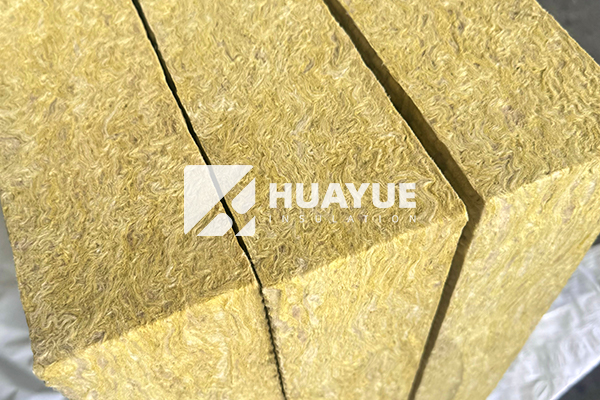
The basic equations are:
Density (kg/m³) = mass (kg) ÷ volume (m³)
Estimated core mass (kg) = length × width × thickness (m) × density (kg/m³)
For example, a 1,200 × 600 × 50 mm unfaced slab has a volume of 0.036 m³. At 60 kg/m³, its estimated core mass is 2.16 kg. At 100 kg/m³, the same dimensions produce an estimated core mass of 3.60 kg. These are mathematical examples, not product availability statements.
The same method works per square metre. Multiply density by thickness in metres: a 50 mm core at 80 kg/m³ equals 4.0 kg/m². If thickness doubles to 100 mm, estimated core mass doubles to 8.0 kg/m² even though density remains 80 kg/m³.
This estimate supports early lifting, support, pallet, container, and freight planning, but it does not certify delivered weight. Density and thickness tolerances, facing, wire mesh, adhesive, coating, moisture, wrapping, cartons, pallets, and accessories can change the result. Confirm both net product weight and gross shipping weight before finalizing structural or logistics decisions.
For conversion, 1 lb/ft³ is approximately 16.02 kg/m³. Keep the original declared unit and its rounding basis when checking compliance. Also confirm whether a quoted figure is nominal, target, minimum, or measured density and which tolerance or test method applies.
How Does Rock Wool Density Affect Performance?
Density can influence handling and product design, but every performance property has its own test conditions and system boundaries.
Higher density may accompany greater rigidity or compression resistance within a particular product family, but it does not automatically improve thermal insulation, sound absorption, fire resistance, moisture control, or service life.
Thermal performance
Thermal resistance depends mainly on the named product’s declared thermal conductivity and installed thickness. Density alone cannot produce an R-value or U-value. Compare thermal data only when product identity, test method, mean temperature, thickness, units, and declared-value basis align.
The installed construction also matters. Gaps, compression, joints, fasteners, framing, penetrations, and thermal bridges can change system performance even when the insulation density matches the specification. If two offers have the same density but different declared conductivity or thickness, they are not thermally equivalent by default.
Acoustic performance
Porous sound absorption depends on thickness, airflow resistance, fiber structure, frequency, facing, mounting, backing, and air space. Sound isolation between rooms depends even more strongly on the complete wall, floor, ceiling, duct, or enclosure assembly.
A density value therefore cannot prove “best soundproofing.” Ask for frequency-dependent absorption data when selecting an absorber and assembly test data when the goal is sound isolation. Compare like with like: the same thickness, mounting condition, frequency range, product form, and test method.
Mechanical performance
Some denser boards are engineered for applications that require firmness or compressive performance, but density is still only an identifier. The project may need compressive stress at a stated deformation, point-load resistance, tensile strength, dimensional stability, or fastener-related data.
Specify the actual mechanical property and acceptance criterion. Do not assume that an unrelated board, batt, or blanket becomes interchangeable because its kg/m³ figure matches or exceeds the scheduled value.
Fire and moisture boundaries
Density does not create a reaction-to-fire classification, service-temperature limit, or hourly fire-resistance rating. Verify the offered product’s applicable classification and the exact tested or listed wall, floor, roof, joint, duct, penetration, or protection system required by the project.
Density also does not prevent condensation, water entry, corrosion under insulation, or mold. Those outcomes depend on water, vapor, air, drainage, sealing, jacket, maintenance, and operating design. A density number should never be converted into a complete-system guarantee.
How Should Buyers Choose Rock Wool Insulation Density?
Good selection begins with the application and required evidence, then narrows to a named product with the correct form, thickness, tests, and installation instructions.
Use density as a product identifier and weight input. Approve a product only after its current technical documents demonstrate the thermal, acoustic, mechanical, fire, dimensional, and system properties relevant to the project.
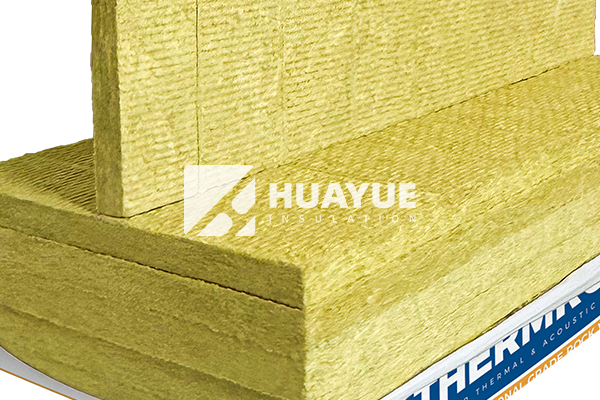
This decision matrix keeps density in the right role:
| Buyer task | Evidence to select first | How density helps | What density cannot prove |
|---|---|---|---|
| Framed wall or roof cavity | Thermal target, thickness, fit, and assembly design | Identifies a grade and estimates weight | R-value, U-value, or gap-free installation |
| Room absorber or acoustic lining | Frequency data, thickness, mounting, facing, and fire requirement | Identifies the tested sample | “Best soundproofing” or wall transmission loss |
| Façade, roof, floor, or loaded board | Compression, tension, point load, fastener, and system data | Helps distinguish named grades | Structural capacity or substitution equivalence |
| Pipe, duct, tank, or equipment insulation | Geometry, operating conditions, thermal data, support, jacket, and corrosion-control design | Supports weight and product-form checks | Temperature limit, condensation control, or CUI prevention |
| Fire-rated construction | Product classification plus the exact tested or listed assembly | Identifies the specified component | An hourly rating for the complete construction |
Does 25 mm rock wool have a fixed density?
No. Thickness and density are independent specifications. A 25 mm requirement defines thickness, not a universal density band. For illustration, a 25 mm core at 80 kg/m³ has an estimated mass of 2.0 kg/m², while a 25 mm core at 120 kg/m³ has an estimated mass of 3.0 kg/m². These calculations do not mean either density is available or suitable for a particular use.
Before approving a quotation, request the product name, form, density basis and tolerance, thickness, dimensions, facing, current datasheet revision, required test reports, application limits, installation guide, package weights, and commercial packing details. Compare alternatives in a compliance matrix instead of accepting “same density” as proof of equivalence.
Use the rock wool insulation product category to identify the required form. For an RFQ, share the application, drawing or dimensions, thickness limit, performance target, quantity, destination, facing, packing, and required documents. Ask for the current HUAYUE named-product datasheet and applicable reports before confirming the density.
Conclusion
Choose rock wool by application and verified product evidence; use density to identify grades and estimate weight, never as a universal quality score.