






“Fire rated mineral wool” can describe a product’s fire-related classification, but it does not automatically mean the insulation alone has a one-, two-, or three-hour rating.
Mineral wool can contribute to passive fire protection, while a time-based fire-resistance rating belongs to a tested or listed wall, floor, joint, penetration, duct, or other complete assembly.
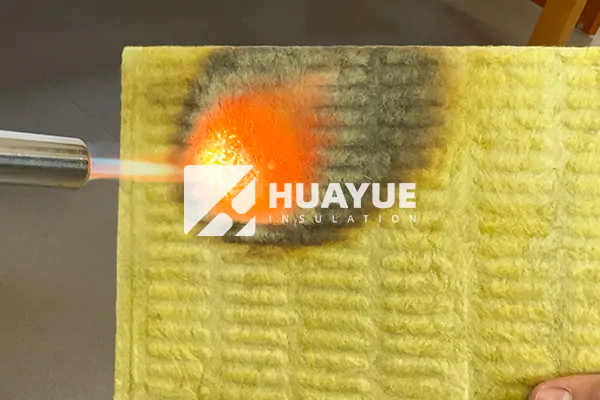
That distinction matters whenever a specification calls for mineral wool insulation fire rating evidence, a mineral wool firestop, or a mineral wool fire barrier. The right question is not simply “Is this mineral wool fireproof?” It is “Which fire property is required, and does the evidence cover the exact construction being proposed?”
What Does a Mineral Wool Fire Rating Actually Mean?
Fire-related wording can refer to more than one type of test or classification.
A mineral wool product may have evidence about its own reaction to fire, while fire resistance measures how a complete construction performs for a stated period under a specified test method.
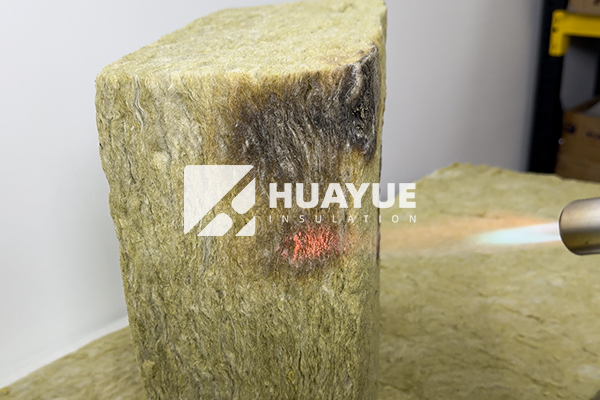
Material-level evidence answers questions about the product specimen. Depending on the applicable market and method, that evidence can address behavior such as combustibility, flame spread, heat release, smoke, or droplets. The exact wording, product form, thickness, facing, coating, substrate, and mounting conditions matter. A result for an unfaced mineral wool board, for example, is not automatically evidence for a faced composite or a different installed configuration.
Fire resistance is a different question. The National Institute of Standards and Technology describes fire-resistance ratings in relation to structural members and assemblies. In code language, a fire-resistance rating concerns the period during which a building element, component, or assembly performs the required function under the prescribed test or a method based on testing. It is therefore unsafe to turn a material class into an hour rating for a wall or floor.
This is also why “fireproof” is usually too vague for a specification. It may hide several separate requirements: a material classification, a noncombustibility criterion, a surface-burning result, a fire-resistance period, or a firestop-system rating. Ask the designer or authority which property is required, then request evidence that names that property. This page’s purpose is to help interpret that evidence; it does not assign a rating to a product.
When Is Mineral Wool Part of a Firestop or Fire Barrier?
Mineral wool can be one component in passive fire protection, but its function depends on the system.
A mineral wool firestop or fire barrier is not defined by insulation alone: the rating and permitted use belong to the specified arrangement of materials, dimensions, and installation details.
The terminology changes the review task. A fire barrier is generally a fire-resistance-rated wall assembly designed to restrict fire spread while maintaining continuity. A firestop system deals with an opening or joint that interrupts a fire-resistance-rated construction. The ICC definitions distinguish fire barriers, through-penetration firestop systems, and fire-resistant joint systems, each with its own stated purpose and test basis.
In a penetration detail, mineral wool may be used with a sealant, collar, wrap, or other components. In a facade perimeter condition, it may be one part of a designed containment system. In a cavity, it may be positioned as a barrier within a prescribed construction. None of those descriptions proves that any mineral wool product can be substituted freely. The approved detail may set limits for the opening size, service type, insulation compression, sealant depth, fasteners, backing, orientation, or movement capability.
Use the system term in the enquiry. If the requirement is for a penetration firestop, supply the penetrant type, opening, rated floor or wall, and target rating. If it is for a cavity or perimeter barrier, supply the relevant wall build-up and location. If it is an ordinary insulated partition, first confirm whether a fire-resistance-rated assembly is required at all. These distinctions prevent a useful insulation material from being specified as if it were a universal firestop solution.
Why a Time Rating Belongs to the Complete Assembly
The components around insulation determine whether a tested construction remains within scope.
Changing boards, studs, fasteners, joints, penetrations, facings, supports, or dimensions can take a proposed wall, floor, or firestop detail outside the evidence for its stated time rating.
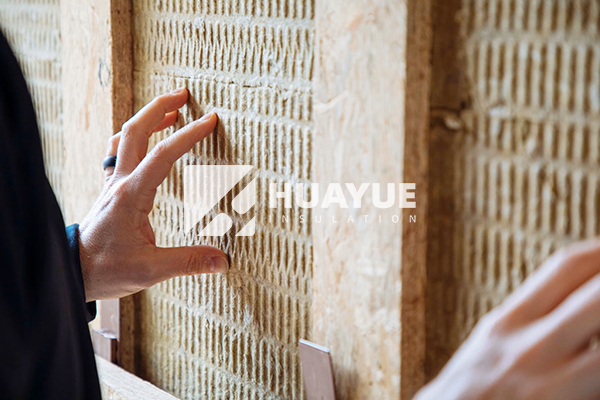
Consider an insulated wall. The result may depend on the framing material and spacing, board type and number of layers, screw schedule, joint treatment, cavity insulation, wall height, load condition, and the permitted services. A floor, shaft, duct enclosure, or curtain-wall perimeter has a different set of interfaces. For a firestop, the opening, penetrating item, annular space, backing, sealant, and support arrangement can be decisive.
The relevant code path is jurisdiction-specific, but the principle is consistent: fire-resistance ratings are assigned to the tested element or assembly. For example, ICC Section 703 describes ratings for building elements, components, or assemblies and separately directs firestop and joint ratings to their relevant requirements. A product data sheet may still be necessary, but it does not replace the complete assembly report, listing, or approved design.
This is especially important during value engineering and substitution. A comparison based only on mineral wool density, a generic “noncombustible” description, or a photograph of a similar detail cannot establish equivalence. The reviewer needs to match the product identity and dimensions to the system evidence, then check all construction conditions that the evidence makes material. If the proposed detail differs, obtain the responsible designer’s or authority’s review before treating the system rating as maintained.
How Should You Verify a Mineral Wool Fire Claim?
A short evidence check is more reliable than choosing by a single marketing phrase.
First identify the required fire property, then match the exact product and installed construction to the relevant test report, listing, approved design, or project acceptance route.
Use this sequence before purchasing or installing:
- Name the requirement. Is the project asking for a material reaction-to-fire classification, a noncombustibility result, an hour-rated wall or floor, a firestop at a penetration, a joint system, or a cavity/perimeter barrier?
- Identify the evidence type. A material claim needs the product-specific classification or test evidence. A time-rated construction needs the complete assembly report, listing, or approved design applicable to that system.
- Match the scope line by line. Check product form, thickness, facing or coating, substrate, fixing, dimensions, joints, penetrations, and orientation against the proposed detail. Record exclusions rather than assuming they are covered.
- Confirm the project route. Check the required code edition, jurisdiction, reviewer, document validity, and any inspection requirements. A report from another market or a different construction may not satisfy the local submission route.
For a product-form discussion, see the site’s rock wool insulation options. For a project fire requirement, begin with the assembly or firestop detail rather than a material name. That keeps the product request connected to the construction it must serve.
Conclusion
Mineral wool can support passive fire protection, but material classification and system time rating are different claims. Share the required system and target rating to start an evidence-based review.